

Treston, manufacturer of industrial sheet metal furniture
Treston Group has a long history as a designer and manufacturer of professional furniture, as well as more than three decades of experience in developing ergonomic workstations. The head office is located in Turku, and our design and production units are located in Turku, Vantaa and Jyväskylä.
Treston is an international supplier of workplace solutions, producing furniture for the needs of industry and other technical environments. The objective is to grow profitably into a leading operator in the Nordic countries and a significant player in Europe. Continuous improvement of operations, personnel development, responsible environmental and quality work, together with a targeted product offering and a broad distribution network, are all aimed at building long-term customer relationships that support the company’s growth targets.
Automatic Lean bending cell
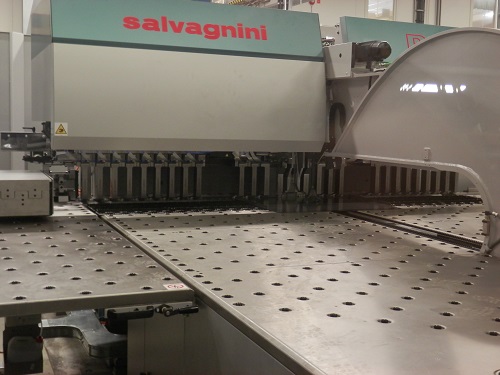
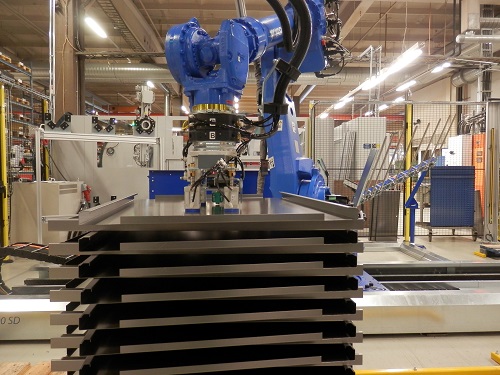
One of the latest equipment investments at the Jyväskylä factory is the Salvagnini P4Lean-2520 automatic panel bender, which is the first delivery to Finland in the 200 mm bending height size range of the new hydraulics-free P4Lean product family. The automatic bending cell is equipped with a modular MC30 loading device. This version is able to feed cut blanks from six different Euro pallet positions into bending in an order-driven process. In addition, at the unloading end of the panel bender, alongside the manual unloading table, a robotic stacking and part-handling station supplied by Yaskawa has been integrated. With this system, different bent products are transferred either to welding or into nine separate stacks on Euro pallet positions, ready to be moved on to the next production stages.
Material-independent flow-through production
At Treston’s Jyväskylä factory, punched and cut blanks are produced with several different punching and cutting cells. Nesting is carried out by minimising scrap material, which means that parts are positioned freely on the sheet in different directions, without taking rolling directions into account. Therefore, in the next process stage, bending, methods are required to ensure consistent quality despite the varying surface stiffness of the cut blanks caused by different rolling directions, material types, thicknesses and so on. Salvagnini’s patented MAC feature, Material Adaptive Compensation, measures the change in springback caused by these material variations for each blank during the bending cycle and corrects the angle correctly in a single pass. This means that part of the factory’s quality assurance is also built directly into the bending process itself.
More versatile bending geometries
One of the most important starting points for the investment project was also to achieve new types of possibilities in bending geometries, both in terms of bend forms and part dimensions. Critical geometries for Treston include, among others, closed forms, for which the selected solution was the so-called Wheel technology. An RSU carriage integrated into the frame of the panel bender’s clamping tools, equipped with a rotary tool, eases the outer edge of the closed bend geometry and enables an extremely tight closed form. During both the initial phase of the procurement process and the delivery phase, visits were also made to Salvagnini’s factory in Austria, where the quality and accuracy of the bending geometries were tested and approved.
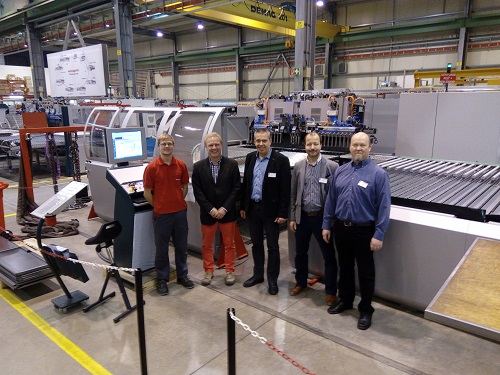
At the trial run at Salvagnini’s Austrian factory, pictured from the right are Treston’s Janne Kuivalainen, Mikko Ahonen and Antero Hakala, together with Fredko’s Pasi Pitkänen.
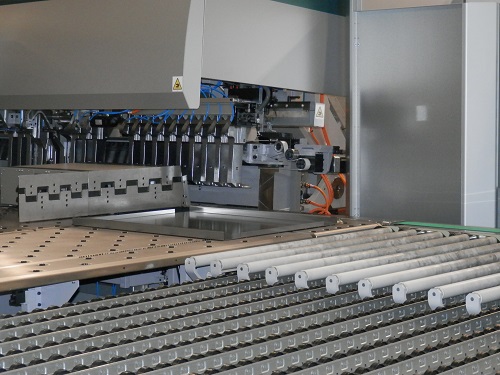
To produce welding or locking tabs, as well as other discontinuous bends, the panel bender was equipped with Salvagnini’s patented CLA-SIM segmented blade solution. The length of the segmented blade is adjusted programmatically from 122.8 mm to 1060 mm in 10.2 mm increments. This allows different tabs to be run through the bending cell without setup times, using only program changes, which can also be made with office software during part programming.
Unmanned production
After punching and cutting, blanks are stacked on Euro pallets in many different optimised ways at the Jyväskylä site. According to the orders, the cut blanks on pallets are directed to the bending cell. The bending cell’s MC30 loading device has six Euro pallet positions, where loading into the panel bender can be programmed freely according to the actual X, Y and Z coordinates of the blank stack on the pallet. Both pallet loading and stack position programming can be carried out while the cell is running, when the loading table is driven from the working area to the loading position. The loading device itself can rotate the part’s loading and positioning direction freely in relation to the stacking direction, thanks to its axis that rotates 360 degrees.
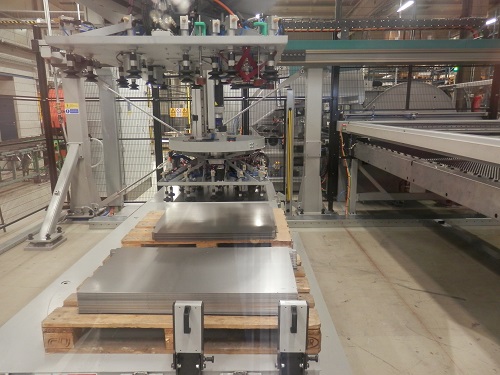
At the unloading end of the cell, a Yaskawa stacking robot is integrated with the panel bender. The robot is able to stack parts onto nine different pallet positions and transfer bent products to welding. The safety area of the stacking robot’s working zone is divided into sectors, allowing completed pallets to be removed while the robot is stacking another pallet position.
In unmanned production, the cell can send status information, for example via a mobile application, on the progress of the ordered bending process directly to the operator’s phone. Remote diagnostics over the internet are used for both maintenance and service connections, by both local customer support and the factory. At Treston, the remote connection can be used to benefit from the extensive application expertise database of the Austrian product development department, built up through experience from more than 3,000 delivered machines from the world’s largest panel bender factory, for example in the development of new products.