

Founded in 1981 and based in Pietarsaari, Oy Elkamo Ab develops and manufactures demanding electrical distribution systems for international markets. The company’s special expertise lies in products for utility distribution networks, as well as main distribution systems for buildings and industry. Elsteel, a subsidiary formed from Elkamo’s sheet metal department, supplies the majority of Elkamo’s sheet metal components in order to ensure operational reliability and flexibility. Jouko Pihlajamaa, the principal owner and Managing Director of the companies, explains that a prerequisite for continuous product development and for reacting quickly to ideas coming from customers is that component manufacturing remains in the company’s own hands.
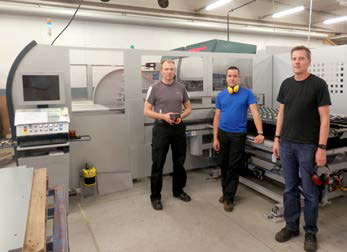
Elsteel’s core team from the left: Petri Uusikartano, Antti Vähätiitto and Janne Högnabba at the new Salvagnini P4Lean automatic panel bender.
From the very beginning, Elkamo has aimed to remain independent of its competitors. For this reason, high-quality European partners form an important part of the company’s operations. With the help of their products and components, this independence has been achieved. As a result, Elkamo has become an equal competitor to large international companies. Thanks to continuous product development, Elkamo today has a truly advanced product range for utility distribution networks, as well as a functional overall solution for main electrical distribution in buildings.
Elkamo has remained on a growth path. In 1981, turnover was 1.5 million Finnish marks; today it is well over EUR 10 million. Long-term product development and a strong partner network also provide a solid foundation for future growth. Pihlajamaa is convinced that by investing in in-house manufacturing, the company can push back against the outsourcing trend that has dominated for more than ten years, while also responding to increasingly tight local competition. Elkamo’s goal is to secure the conditions for growth by investing and increasing added value.
The new generation of fast and easily programmable machine tools also enables cost-effective small-series production, as long production runs are no longer a prerequisite for cost-efficiency. Setup times have also been shortened thanks to advanced automation solutions. The functionality of the machines acquired is ensured by Finnish, factory-trained spare parts and service support.
In Pihlajamaa’s view, using an external manufacturing subcontracting network also makes efficient product development more difficult. Partners were expected to bring fresh ideas with them, but this was often not the case. He believes in an operating model where customer needs coming through sales and product design are closely involved in both the manufacturing and manufacturability of the product. In this way, high-quality product development is created, while at the same time ensuring the cost-effective manufacturability of the products.
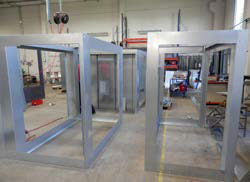
The sheet metal parts for Elkamo’s outdoor transformer substations are manufactured order-driven at Elsteel, directly in assembly sequence.
More efficiency for busbar production
Busbars are most often manufactured from aluminium bars, but depending on the requirements of the customer or market area, also from copper. At the beginning of this year, Elkamo invested in both a Holecut 40-6 CNC punching machine from the Standard product family of the well-known German manufacturer EHRT, and an EB 30 CNC bending machine. In addition to improving profitability, these machines have raised the technical level of production and thereby the overall profile of manufacturing, while also inspiring the production personnel.
The punching unit of the Holecut moves transversely in the Y direction. Longitudinally, in the X direction, the bars are fed with a gripper feed unit. The unit has six tool stations, using quick-change tools developed by EHRT. The punching speed is 80 strokes per minute. The maximum bar width is 200 mm and the maximum thickness 16 mm.
The bending machine is equipped with the manufacturer’s springback compensation method, which enables an accuracy of up to ±0.2 degrees. EHRT machines are programmed using a graphical user interface. Programs can also be edited directly from the machine control. The bar blank length required for cutting and punching is obtained directly from the bending program.
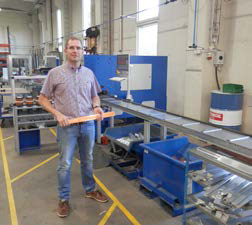
Elkamo’s Financial Manager Andreas Hanstén says that EHRT’s bar processing machines have improved efficiency.
Automatic panel bender makes bending more efficient
Elsteel has acquired a Salvagnini P4Lean-2116 automatic panel bender, with a maximum bending length of 2180 mm and a flange height of 165 mm. The maximum sheet thicknesses that can be processed are 3.2 mm for steel, 2.5 mm for stainless steel and 4 mm for aluminium. The system’s HPT loading and unloading table enables flexible handling of cut blanks and bent parts in single-piece and small-series production.
Salvagnini’s patented MAC system measures and immediately corrects the bending angle according to material springback. This means that every single part, even when fed and bent one after another from different materials or thicknesses, is dimensionally accurate right away. The system is based on a Direct Drive solution formed by servo technology and a maintenance-free closed-loop cylinder system.
Previously, the sheets were bent on manual press brakes, where setup times were long for short production runs. Intermediate buffers that disrupted flow also often accumulated. The test pieces required when starting a new part also took time and created material waste. With Salvagnini’s automatic panel bender, tool setup times between products are truly zero, and no test pieces are needed for fine-tuning when changing programs or materials.
Products are manufactured order-driven directly for same-day deliveries, according to the needs of both assembly and other downstream work stages. Bringing Salvagnini into production was faster than expected. In a short time, nearly two hundred bending programs have already been created. One operator can now complete, faster than before, the amount of work that previously required four to six operators and four press brakes.
Productivity is expected to improve further as Salvagnini’s FlexCell principle is used more extensively. In this concept, blanks are processed as completely as possible on the automatic panel bender, while the machine operator performs special and finishing bends on the adjacent press brake. The larger the blanks and the more complex the geometries produced with the automatic system, the fewer operators are needed compared with manual press brake technology. During a shift, as many as around ten employees can be assigned to other tasks.
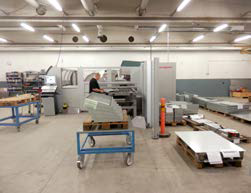
Small batches, or even single parts, can be manufactured flexibly and with dimensional accuracy without setup times.
VEIJO KAUPPINEN