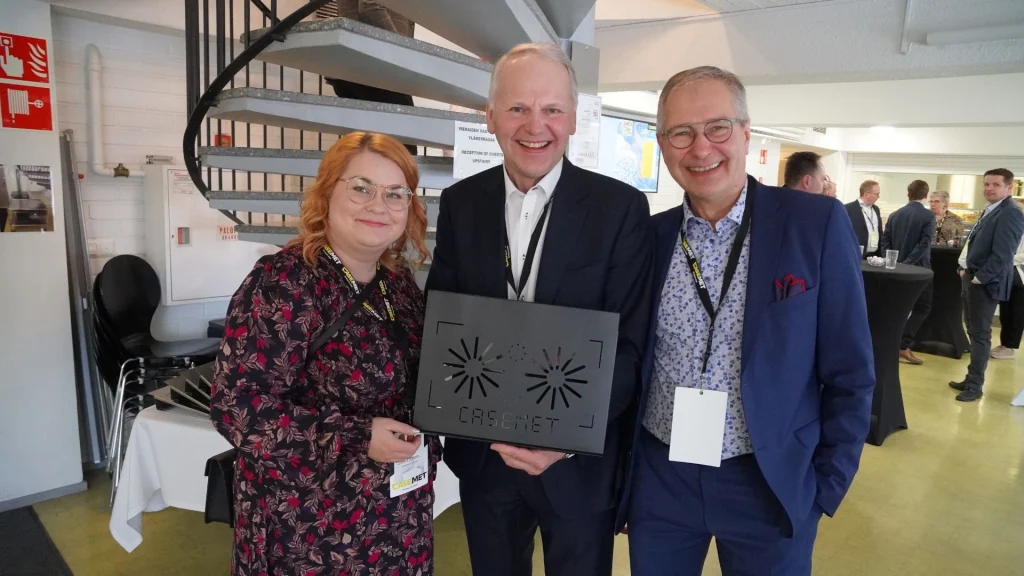


A Grand Opening event was held on April 20th at Casemet’s factory in Mikkeli, where the AJS sheet metal processing system, Automatic Job-Shop System, supplied by Italian manufacturer Salvagnini, was formally taken into production. The system consists of an MBT twin-tower material storage system, an S4Xe punching and right-angle shearing center, an MC buffering, stacking and loading unit, and a P4Lean-3125 Cut Option panel bender. Opening speeches were given by former minister and current agricultural entrepreneur Jari Leppä, as well as Casemet’s CEO Jukka Kokkonen and COO Sanna Vihersalo.

Casemet has factories in Mikkeli, Finland, and Pärnu, Estonia. The Mikkeli factory manufactures metal enclosure solutions for demanding operating environments, as well as electromechanical products and sheet metal-based products and structures. The Pärnu factory, in turn, specialises in subcontract manufacturing of complete solutions and mechanical components for companies in the electronics and mechanical engineering industries.
“Salvagnini’s new S4-P4 production system is the largest single machine investment in the 49-year history of the Mikkeli factory, measured both by physical size and monetary value,” stated Jukka Kokkonen as he opened the event. Before the Casemet era, the Mikkeli factory was part of Ensto, and Jukka had worked at the factory before becoming an entrepreneur, so he was also well acquainted with the factory’s history.
“The supplier selection for this new investment was a multi-stage process. First, we asked manufacturers to provide part-time and suitability analyses, as well as corresponding quotations, for both our own products and contract-manufactured products. After this, we held test sessions at the manufacturers’ showrooms, where part programs and nests were generated directly from the 3D models we brought with us, without any pre-preparation, and the parts were then manufactured,” explained Sanna Vihersalo, continuing:
“Based on the evaluation criteria we had created in advance, we continuously scored the different areas, and this gradually began to reveal differences between the suppliers. Salvagnini’s strengths and differentiating factors included digital manufacturing with 3D office programming using the Stream product family, the material savings achieved and the capacity increase in cutting, as well as the genuine implementation of Lean principles in bending, for example through the MAC 3.0, Material Adaptive Correction, measurement and correction feature.”
The factory structures set the boundary conditions for the layout design of the system. As a result, the MBT twin-tower solution was selected as the material storage system, with around thirty 3-ton sheet stack locations. From the SMD rapid storage module, six different sheet blanks can be loaded into cutting consecutively at intervals of 25 seconds.
The energy-efficient and quiet servo-controlled S4Xe punching and right-angle shearing center produces blanks for bending with an optimised cycle and is also capable of machining blanks unmanned during evening, night or weekend operation onto 18 different Euro unloading pallets. These are arranged within a compact floor area thanks to their Matryoshka-type overlapping structure. The MC stacking and loading unit can dynamically buffer the feed of cut blanks to the panel bender if there are major differences in cycle times, or load blanks cut on another cutting center for bending.

“One significant differentiating factor in bending was Salvagnini’s Bend and Cut feature, Cut Option, for narrow products, which can be run either as filler parts connected to larger panels or as so-called comb-nested blanks. In addition, the three T-Tool bending-tool change system of the P4Lean 3125 model enabled the automatic change of relief plates required especially for the drawn features in our enclosure products, as well as alternating use of the cutting blade,” emphasised Jukka Kokkonen.
“With the Bend and Cut feature, we can transfer profile products that were previously made in our production by manual press brake bending into the scope of automated bending,” added Factory Manager Karo Häkkinen during the demonstration tour he led.
During the tour, Minister Jari Leppä officially started up the new AJS production system, thereby becoming part of the Casemet tribe, as he had called for earlier in his ceremonial speech by encouraging the strengthening of local tribal spirit and emphasising the importance of investments as an enabler of growth.
“The targets Casemet set for its new production system, such as the ability to replace the capacity of the existing two to three cutting machines, an automatic bending process for frequently changing small series, and fully digital manufacturing, were demanding and challenging. However, thanks to Salvagnini’s broad and modular offering, exactly the right combination of solutions for these needs was found through several rounds of analysis and iteration. Also significant were the software interfaces created through Salvagnini’s own product development, which bring real competitive advantage to a digital manufacturing environment,” described Pasi Pitkänen, Managing Director of Fredko, on how the process progressed. He continued: “In my opinion, however, the most important thing was and still is to achieve the simulation results in the process during the practical test phase and, in particular, to meet or exceed these defined expectations in real production.”
Fredko Oy Ab represents Salvagnini in Finland and Estonia. Salvagnini Scandinavia is responsible for the factory’s local customer service support and maintenance agreements, which also include comprehensive remote diagnostics and proactive monitoring through the Links cloud service. Casemet also uses all these services to support production with as few interruptions as possible.