

Fredko story
As a young man, Leif Fredriksson worked as an engineer at the Enbom engineering works in Pitäjänmäki and later at Fincoil (A. Pakula Ky). Both companies operated in the sheet metal industry, which also brought him into contact with sheet metal machinery suppliers. He became so interested in the sales of sheet metal processing machinery and automation that the idea of starting his own company began to take shape. He founded Oy Fredko Ab in his home in Immersby, in what was known as the “swimming pool room”, on 15 February 1974. According to the company’s Articles of Association, its purpose was to import, manufacture and sell machinery, machine parts and machinery-related products for the engineering and construction industries.
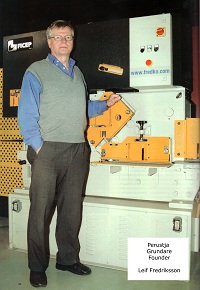
The shareholders were Leif Fredriksson with 98 shares, Carl-Henrik Nyberg with one share and Barbro Fredriksson with one share.
At a very early stage, cooperation began with Hans Stork from Stockholm. He established a Finnish subsidiary, Oy Stork Ab, which sold products including Trafag thermostats.
Fredko wanted to expand its product range, and these thermostats were a suitable addition. This marked the beginning of intensive cooperation with Stork. Hans Stork accompanied Leif Fredriksson to numerous trade fairs around Europe and introduced him to his own contacts. As a result, Italy, with its competitively priced machinery and manufacturers eager to cooperate, came to play an important role in Fredko’s future development.
The first Italian supplier was Salvagnini. The connection began through a brochure that Leif Fredriksson picked up at a trade fair. Salvagnini’s owner, Guido Salvagnini, in turn introduced Fredko to Stam and Luigi Saccà. Cooperation with Stam has therefore continued without interruption since 1975. Other Italian manufacturers included Cemsa, GPA and Iron. Salvagnini transfer lines with hydraulic servo technology and CNC controls were added to the product range, along with the first S4 and P4 machines. Later, in 1995, also in connection with a visit to the Blech trade fair, Leif Fredriksson established contact with the Milan-based structural steel machinery manufacturer Ficep.
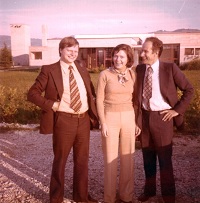
Naturally, however, contacts were also sought in Sweden. The first company to join the range was Bröderna Wikström in Skellefteå. They manufactured hydraulic punching units that Leif Fredriksson had previously purchased for Fincoil. The first production line built under the Fredko name was created together with Toolsystem and Veikko Pitkänen (Pasi Pitkänen’s father). It consisted of a GPA feeding unit and the aforementioned punching units, with a hydraulic unit installed between them. At the time, the availability of ready-made components was quite limited, so creativity was required when assembling complete production lines. Fumex drilling and threading units came next, followed by eccentric presses from Aros Verken in Smålandsstenar.
Tranemo/AP&T has also been involved from the very beginning. AP&T (Automation, Pressar och Verktyg) was established in 1989 when Tranemo Hydraulmaskiner, Lagan Press and Vibab merged. However, Tranemo founder Håkan Salander had already sold one Tranemo line to Fläkt in Perho before cooperation with Fredko began. Soon afterwards, in 1974, Fredko sold its first Tranemo line to Fläkt in Turku, and the person who installed it was Sven-Arne Merkel. He has therefore been involved with Fredko since the very beginning, and many Tranemo presses have been sold since then, including to companies such as Stera and Asko.
New additions to the product range in 1991 included Swedish Ursviken press brakes and shears, as well as Pullmax machines such as the X97 bevelling machine.
Germany and German manufacturers were also represented. Machines from the German supplier Behrens were among the first machines sold by Fredko, and the cooperation continued for many years. Another important German principal was Burkhardt+Weber, a manufacturer of metal-cutting machine tools.
For a newly established company, attending trade fairs was extremely important. Leif Fredriksson visited numerous exhibitions throughout Europe to gather ideas for new products and establish new supplier relationships. It was during one such trade fair visit that Turkey was added to Fredko’s supplier network. At the Blech trade fair in 1997, the first Durma press brakes and shears were ordered. The first Durma shipment arrived in Finland in September–October 1997. Cooperation with the Turkish press manufacturers Dirinler and Sahinler began one year later.
Among the more unusual products manufactured by Fredko over the years were foot files. Fredko produced Dr. Scholl foot files for Instrumentarium at a rate of more than 100,000 units per year for several years. This continued until Instrumentarium was sold and it was decided that outside manufacturers could no longer use the Dr. Scholl name. The production line consisted of a GPA feeding unit, pneumatic cylinders and adjustable carbide tools, after which the adhesive was applied manually. Leif Fredriksson assembled the production line himself.
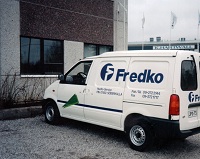
The Fredko products best known to the general public were transport trailers and horse trailers. Production was later transferred to the subsidiary Freson. The mud flaps carried the FREDKO name, and even ten years after production had ended, customers were still calling to ask about spare parts. Many of the trailers are still in use today!
Fredko also maintained important contacts with Finnish manufacturers. For example, Leif Fredriksson purchased an eccentric press from Hämeskone/Hämäläinen for Fincoil. The circle was completed on 1 July 2008 when Hämeskone became part of Fredko. As part of the acquisition, several well-known manufacturers and brands came under Fredko’s representation, including Dimeco, EHRT, PMB, Mäder Pressen and Zopf.
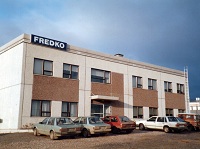
Fredko has moved several times since its beginnings in the “swimming pool room”. From 1975 to 1980, the Municipality of Sipoo rented Fredko club premises on Tarapotintie in Söderkulla. Planning for a new office began in 1979. The first industrial building at Hiekkamäentie 8 was completed in 1980, with Alucrom, now FSP, moving into one half of the building and Fredko into the other. A second building, the “Fredko hall”, was completed in 1982. Fredko then moved into the new building, while Alucrom took over the entire first building. FSP remains a tenant there to this day – a remarkably long and successful tenancy.
In 1984, the Paavo Rannila Group, which later became part of Rautaruukki, acquired a stake in Fredko. This ownership arrangement continued until 1992. The new owners wanted Fredko to operate under the same roof, so in 1985 the company moved to Linjatie 5 in Vantaa. This phase lasted until 1992, when Leif Fredriksson bought Fredko back on 1 February 1992. Fredko once again became a Sipoo-based company. During Fredko’s absence, the Fredko hall had been rented to K. Hartwall. When Fredko returned, Tuoteteline and Grafituonti were tenants in the warehouse section and also occupied part of the office space. Within just a few years Fredko had grown to the point where it once again needed the entire building for its own operations.
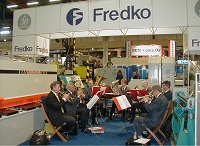
Participating in trade fairs with its own stand became relevant in 1987. Fredko has participated in every FinnTec exhibition held since then. Demonstrating the importance Fredko places on customer relationships, the company celebrated its 30th anniversary at its own stand during FinnTec 2004, accompanied by the Sipoo Brass Band.
A concept that still applies at Fredko today is to use trade fairs to discover new ideas, expand the product range and establish new supplier relationships. In recent years, many new manufacturers and products have been added to Fredko’s portfolio, including Adige, BLM, Mobil Mark, TTEngineering, Zani, Eckert and Firmac.
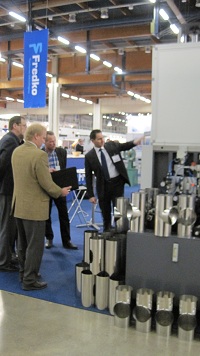
Another circle has now been completed with the return of the representation of Salvagnini’s well-known machines to Fredko after a 20-year break. The break began when Salvagnini decided to handle marketing in individual countries under its own name. At that time, Fredko’s Jukka Majuri moved to Salvagnini to take responsibility for the Finnish market.
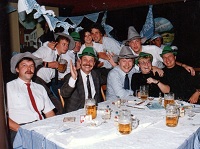
In addition to taking care of its customers, Fredko has always looked after its employees. Under Leif Fredriksson’s guidance, several employees went on to become independent and successful entrepreneurs, including Tapani Laaksonen of Tarkkuuskoneet. Fredko has always valued its skilled employees highly. Life at the company has therefore not been all about everyday work: Christmas parties have also been an important tradition. Initially these were celebrated together with the employees of Stork, and over the years celebrations have been held at around a dozen different venues in Helsinki, Sipoo, Vantaa and Porvoo, ranging from Nevas Manor to Haikko Manor.
One indication that employees have enjoyed working at Fredko is that many have remained loyal to the company for several decades and have even wanted to continue working for Fredko after retirement.
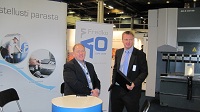
The concept for the future remains the same as it was 40 years ago: good relationships are built through trade fairs and customer visits. Without the support of our valued customers and principals, this 40-year journey would not have been possible. We will continue to keep pace with developments in the industry and serve our customers to the best of our ability by offering competitive and efficient machinery.
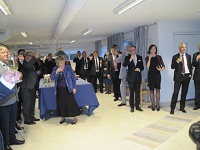
On 2 October 2014, we celebrated our 40th anniversary under the leadership of our Managing Director, Pasi Pitkänen, together with customers, suppliers, long-standing customer contacts, current employees and employees from earlier years.